Struggling to retain information despite hours of study? You’re not alone. Traditional learning methods, often heavy on text and rote memorization, frequently fall short because they don’t align with how our brains are naturally designed to learn and remember. Discover groundbreaking insights into effective learning strategies that leverage our innate cognitive abilities, transforming your approach to knowledge acquisition and boosting long-term memory retention.
Why Your Brain Prefers Experience Over Pure Text for Learning
Our brains are remarkable biological machines, honed over millennia to thrive on dynamic, sensory-rich experiences, not static text. Early human survival depended on learning through movement, emotion, spatial awareness, and direct interaction with the environment and potential threats. This fundamental evolutionary wiring means that when learning relies solely on abstract text, our capacity for deep understanding and lasting memory retention is significantly diminished. To truly embed information, consider shifting towards experiential learning approaches that engage multiple senses and mimic real-world scenarios, fostering a more natural and effective cognitive process.
Unlock Superior Memory with Dual Coding Theory
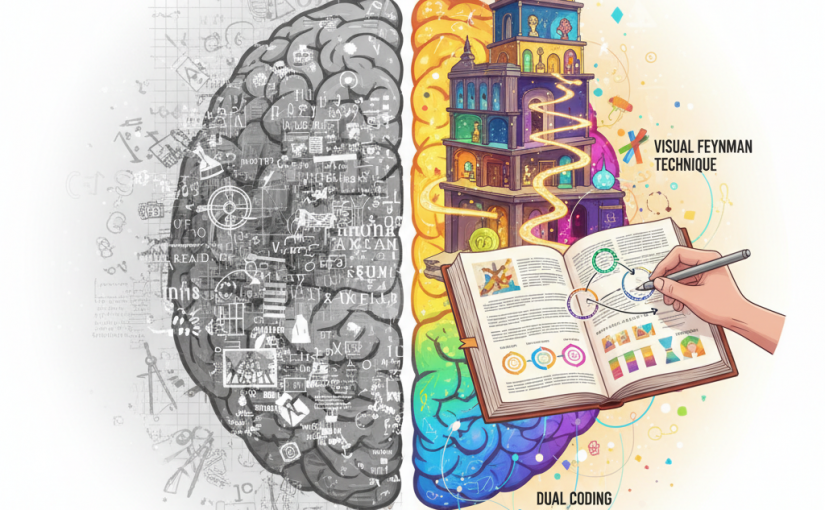
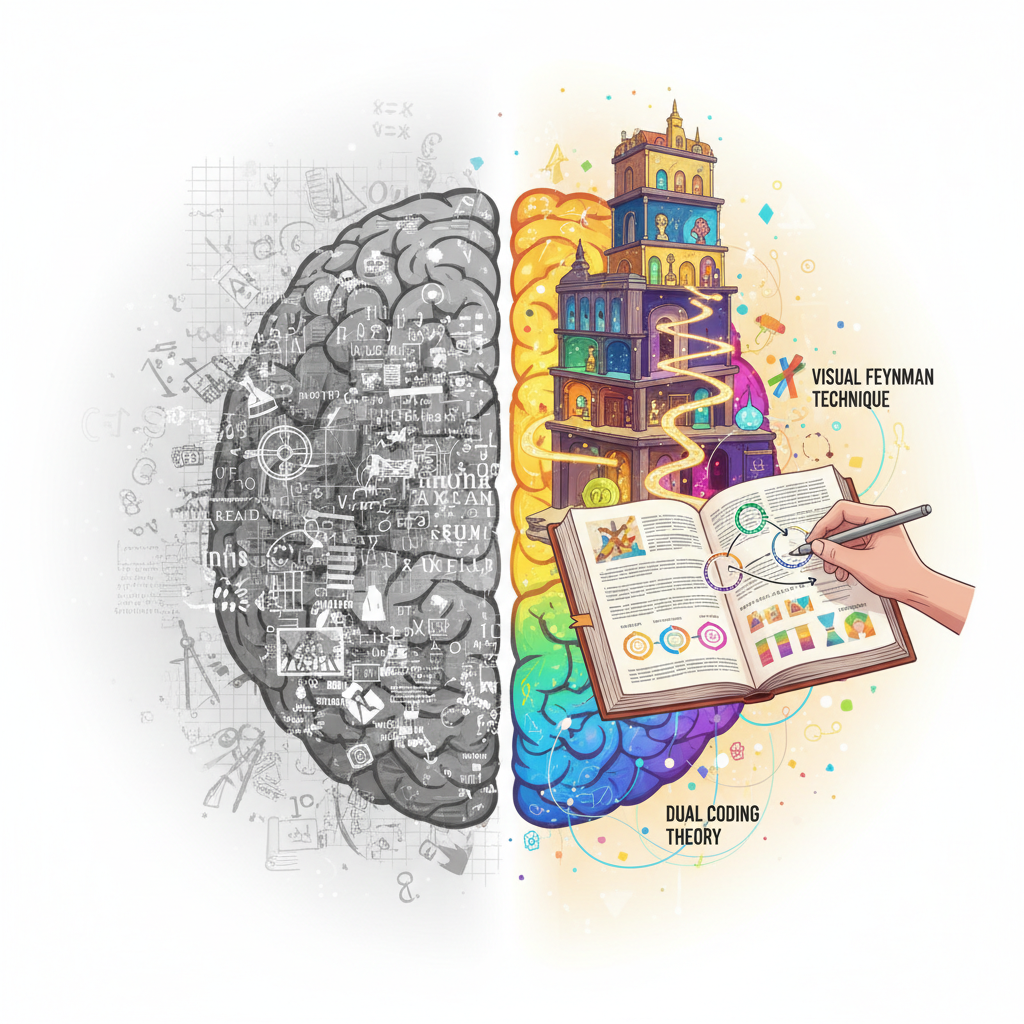
To dramatically enhance memory and comprehension, cognitive science points to the power of dual coding. This effective learning strategy harnesses the brain’s two primary memory channels: the verbal channel for words and the visual channel for images. When you integrate both, such as combining written concepts with relevant diagrams, infographics, or compelling slides, you create a richer, more robust mental representation of the information. This synergistic approach, foundational to multimedia learning, allows for more pathways to recall and significantly outperforms text-only methods for boosting retention and deepening understanding.
Leverage Spatial Memory: The Ancient Secret to Recall
History’s most powerful memory techniques, like the venerable Method of Loci (or “memory palace”), unequivocally demonstrate that human memory is profoundly spatial and visual. Our brains are hardwired to remember locations, scenes, characters, and actions with remarkable precision. By associating abstract information – be it formulas, definitions, or complex ideas – with vivid, imagined spatial environments, you transform inert data into an engaging narrative. This ancient mnemonic device proves that visualising concepts within a familiar mental landscape is far more effective for recall than attempting to memorize isolated facts, tapping into our innate spatial reasoning abilities.
Transform Information for Deeper Learning and Retention
Effective learning transcends mere repetition; its true power lies in the active transformation of information. Rather than passively absorbing content, engage your brain in the dynamic process of converting knowledge into different formats. This could mean translating text into illustrative images, distilling complex ideas into relatable metaphors, or crafting concepts into compelling stories. This active encoding process compels the brain to process information more deeply, forge stronger neural connections, and encode experiences in a way that significantly enhances long-term recall and mastery, moving beyond surface-level comprehension.
Master Concepts with the Visual Feynman Technique and Strategic AI
The Visual Feynman Technique stands as a cornerstone for true understanding. This powerful method encourages learners to simply draw an idea or concept to prove their comprehension, forcing a simplification and visualization that reveals gaps in knowledge. While crucial for active encoding, artificial intelligence can serve as a powerful support tool. AI can generate helpful metaphors, provide alternative explanations, or test your understanding after you’ve engaged in the initial visualization and explanation process. However, it’s vital that AI does not replace the active cognitive work, as this would bypass the very encoding process essential for memory development. Additionally, ensuring adequate sleep remains paramount for the consolidation of these visually-rich memories, solidifying learning gains.