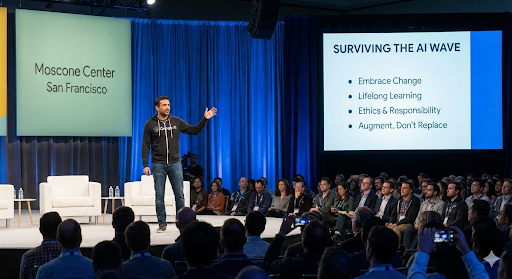
In a world where AI is becoming ubiquitous, will you be swept away by the tide or ride its crest?
Mo Gawdat, the former Chief Business Officer of Google [X] and a renowned thinker, recently shared four provocative pieces of advice. He argues that the arrival of AI isn’t just a simple technical upgrade—it is a fundamental redefinition of what it means to be “human.”
If you’re still using AI just to find recipes or write template emails, you’re missing the core of this revolution. Here are Mo Gawdat’s four rules for survival and success in the future:
1. Stop “Stupid” Usage—Unlock Deep Intelligence
“AI is the ultimate tool of intelligence; don’t use it as a mediocre assistant.”
Most people ask AI things like, “Help me write a sick-leave note” or “What should I have for dinner?” Mo Gawdat points out that this is a waste of a world-changing tool.
• The Real Power: Use it for Deep Searches.
• The How: Use AI to dig into the underlying logic of knowledge, solve complex cross-disciplinary problems, and expand the boundaries of your own brain.
• The Core Logic: Whoever masters the skill of knowledge acquisition will be miles ahead of the average person in terms of cognitive depth.
2. Human Connection: Your Final “Unfair Advantage”
“The best artists might be machines, but the best life performers will always be humans.”
When AI can perform 99% of skill-based tasks, the only thing that cannot be replicated is deep human resonance.
• The High-Value Roles of the Future: It won’t be the person who writes the best code, but the salesperson who builds deep, trusting relationships, or the performer on stage who touches the soul.
• The Reminder: Don’t forget the connection we felt when we met face-to-face years ago. In the AI era, social intelligence, empathy, and authenticity will become your most expensive luxuries.
3. Ethics: The AI “Emergency Brake”
“Our decisions are not made through our intelligence; they are made through our ethics.”
AI is a mirror. It is learning our language and logic, but more importantly, it is learning our values.
• The Danger: If we as a society lose our moral compass, the AI “fed” by our behavior will become extremely dangerous.
• Our Responsibility: We must teach ourselves and the next generation Ethics. Since AI will soon manage the world’s operational logic, that logic will be a direct reflection of our ethical choices.
4. Find the Truth in a Forest of Lies
“In a world manipulated by media and algorithms, nothing you are told is absolutely true.”
Since the 1970s, the media has been a machine for mind manipulation. Now, powered by AI, this manipulation is ten times more potent.
• The Survival Skill: Debate Everything. * The Counter-Intuitive Use for AI: When you hear a popular opinion, take it to an AI and ask: “What is wrong with this? Are there any lies here? Is there an alternative view that is missing?”
• The Goal: Use the vast knowledge of AI to break out of your information cocoon and stay “awake.”
💡 Final Thoughts
AI will not replace you. However, a person who uses AI for deep thinking, possesses extreme empathy, and stands firm in their ethics will certainly replace those who stand still.
The future belongs to those who dare to question the “truth” and those who know how to connect with the human heart. Are you ready?